Set up a fold-away stretching space in a small living room
· Editorial team newswithlauraseattle.com
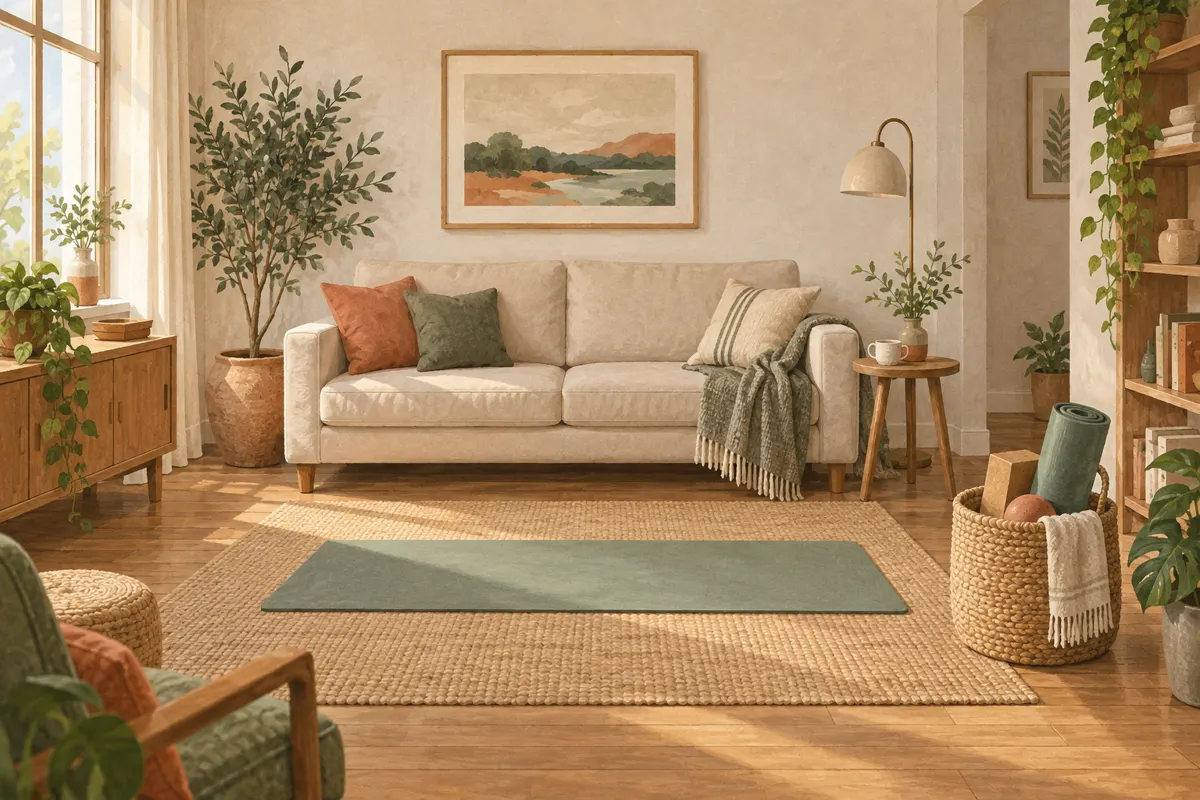
Create a fold-away stretching space by choosing a clear patch of floor, checking the space around and above it, and keeping a mat and a few accessories together nearby. The proposed setup below uses your living room’s existing layout, with a simple routine for opening the space and putting it away afterward.
Choose a floor area that fits your movements
Start with the floor area you can actually clear, rather than an empty-looking corner. A spot beside the sofa or between seating and the TV may be workable, provided it leaves access to doors and does not block the room’s main walking route. Look for a place that requires moving as few items as possible.
- Lay out your mat, or measure its footprint if you have not chosen one.
- Check whether you can lie down with your arms and legs extended without touching furniture.
- Slowly check the reach needed for the seated and standing movements you intend to do.
- Look for nearby table corners, shelving, window ledges, and anything fragile within reach.
- Make sure another person can pass through the room without stepping across your mat.
If a position does not fit, change the mat’s orientation or choose another spot. Do not assume that fitting the mat on the floor means every movement will fit around it.
Check overhead clearance and the floor surface
Check above the space as well as beside it. Pendant lights, ceiling fans, hanging plants, and low shelves can sit in the path of raised arms. Turn a ceiling fan off while checking clearance, and choose a position where you cannot reach its blades. Keep hanging objects outside your intended movement area.
- Remove toys, shoes, loose cables, and other small objects from the floor.
- Check that the floor is dry and the mat lies flat.
- Check that the mat does not slide on the surface beneath it.
- Move any loose rug that bunches or shifts under the mat.
- Keep doors from opening into the space while it is occupied.
Place any screen you use for guidance where you can see it without putting its stand or charging cable in your movement area. Use enough light to see the mat edges and nearby furniture clearly.
Make furniture easy to move and return
Small-space design sources suggest multifunctional furniture and compact pieces that can be tucked away when they are not needed. These ideas can support a living room that changes use during the day. Jena Hall Designs discusses dual-purpose tables, while Resource Furniture describes nesting stools, ottomans, and furniture with storage.
Our proposal is to give each movable item a specific parking place. A small side table might sit beside an armchair during stretching; a footstool might tuck under a console if it fits. Keep those temporary positions clear of exits and walkways. Avoid a setup that requires shifting a heavy sofa every time.
Try the arrangement with your existing furniture before buying replacements. Notice whether clearing the floor creates another obstruction elsewhere. If it does, simplify the layout or choose a different stretching spot.
Give the mat and accessories one storage home
Resource Furniture recommends assigning belongings a designated place and using hidden storage where appropriate. For this setup, the editorial proposal is to keep your stretching equipment together in an existing cabinet, storage ottoman, or suitable basket near the chosen floor area.
- Check that the opening and interior fit your mat when rolled or folded as intended.
- Include only the accessories you actually use, such as a stretching strap or blocks.
- Choose a spot you can reach without unloading other belongings.
- Follow the mat’s care instructions, including drying it before storage when needed.
Use the same reset routine each time
A repeatable reset makes the shared room easier to use afterward. Treat putting things away as part of the session, with the mat’s storage place and the furniture’s usual positions already decided.
- Gather accessories and return them to their storage spot.
- Clean or air the mat as its care instructions require, then put it away.
- Return the table, footstool, or chair to its usual position.
- Check that cables, doors, and walking routes are clear.
If one part of the routine repeatedly feels awkward, change that part of the setup. Moving the storage basket closer or removing an unnecessary accessory may be enough to make the space easier to use.